
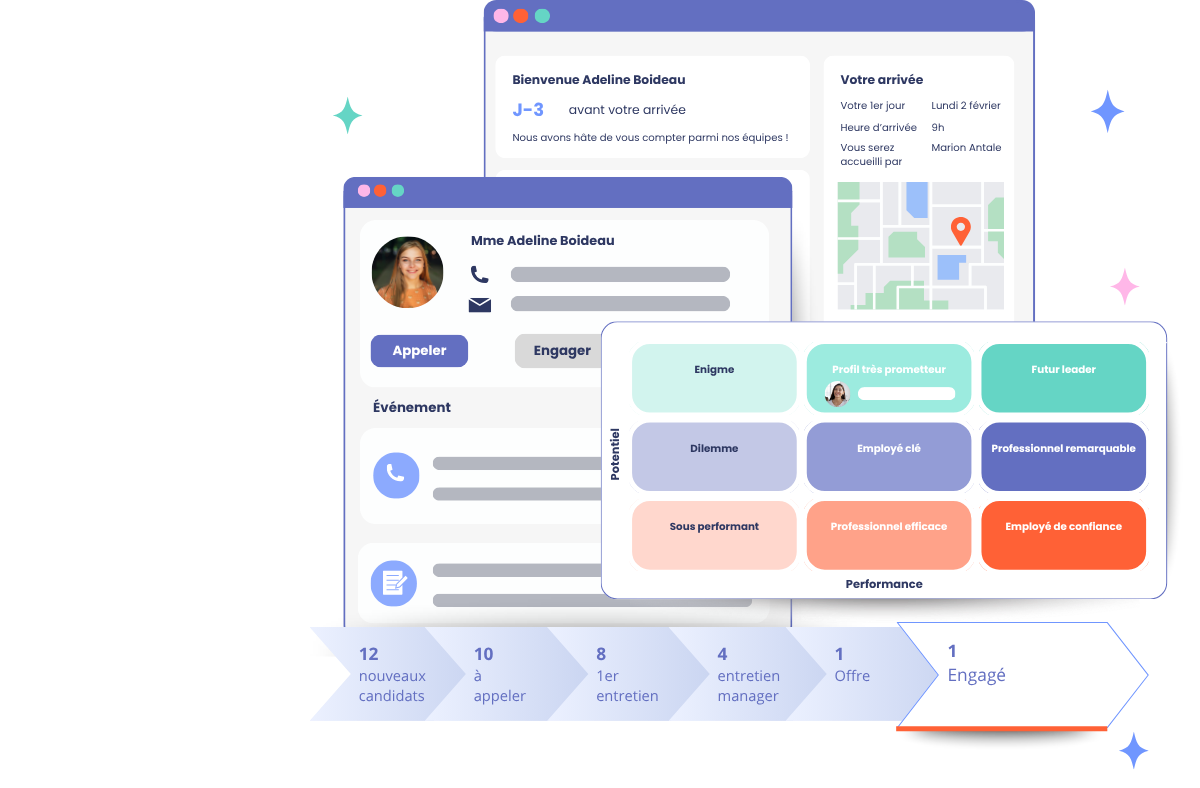
mpleo: the complete HRIS software that simplifies and automates your HR management
A HRIS software designed to make the daily tasks more fluid of HR teams, managers, and employees
mpleo is a comprehensive HRIS software designed to make HR management simpler, more reliable, and smoother.
It allows you to manage all your HR processes from a single environment: recruitment, onboarding, interviews, skills, training, and administrative management.
With this centralized management, you save time, secure your data, and enhance both the employee experience and your organization’s performance.
Modular and scalable, mpleo easily adapts to your company’s size and priorities. Activate the modules you need today and evolve your HRIS suite as your business grows.

The main features of the HRIS mpleo software
All your HR processes are in mpleo! Build the HRIS software that meets your needs.

Recruitment

Onboarding

Review management

Skills management

Succession Planning

Training & Authorization management

Career Management

Attendance and absence management

Time tracking

Timesheet

Personnel management

Vehicule Fleet management

HR Digitization

Why choose the mpleo HRIS software?
With the HRIS software mpleo, recruitment, onboarding, training, reviews, skills, and administration are all centralized in one place. Result: streamlined management, faster and more reliable.
All employee data is centralized in a single HRIS software. This ensures reliable decision-making, reduces errors, and improves the quality of HR information.
The HR management software mpleo easily connects to your payroll software, ERP, or business applications. Goal: eliminate duplicate entries and ensure complete consistency.
Activate only the HR modules you need and let your HRIS software evolve at your organization’s pace.
Join the 200+ companies and 100,000+ HR professionals who trust us






HRIS software: definition, uses, and benefits for HR
A Human Resources Information System (HRIS) is a software solution designed to streamline and optimize HR processes in a simple, reliable, and efficient way. Organizations investing in an HRIS typically seek to structure and professionalize their HR management, reduce administrative workload, and access up-to-date data to support informed decision-making.
Their expectations generally revolve around three core objectives: securing HR data, automating administrative tasks, and enhancing collaboration across all stakeholders within the organization.
Centralize All HR Data for Greater Consistency
Centralizing information is one of the primary benefits expected from an HRIS software. In many companies, HR data remains scattered across Excel files, emails, shared folders, and unconnected tools. This fragmentation leads to re-entry, time loss, and errors.
A good HRIS software should enable the consolidation of all HR data into a single, structured environment.

Gather all employee information in one place
An HRIS solution allows you to consolidate all employee data in one location: personal information, HR documents, training history, certifications, evaluations, skills…
Ensure reliable and up-to-date HR data
When information is updated in one module, it is automatically refreshed in other relevant areas. This synchronization enhances data quality and reduces discrepancies in HR processes.
Reduce duplicates and errors
Fewer re-entries mean fewer risks of errors, especially in sensitive areas like payroll, compliance, or administrative tracking.
Provide a clear view of the employee journey
With an HRIS software, the stages of the employee lifecycle become clearer: recruitment, onboarding, training, evaluations, and internal development. An HRIS software like mpleo provides the necessary visibility to structure, secure, and streamline talent management daily.
Automate Administrative Tasks to Free Up HR Time
Companies also expect an HRIS software to automate repetitive, low-value tasks. The goal is clear: reduce the operational burden on HR teams so they can focus on more strategic missions.

Recruitment, onboarding, performance reviews, training, and administrative management: an HRIS software enables the standardization of workflows, making them more consistent and easier to manage.
An HRIS solution allows you to automate follow-ups, deadline reminders, and notifications for managers and employees, significantly reducing the risk of oversight.
Employment contracts, amendments, policies, internal regulations, and administrative documents can be automatically generated from existing data and integrated into digital signature workflows—resulting in substantial time savings.
Medical check-ups, probation periods, certifications, mandatory reviews, and compliance training: an HRIS software facilitates the monitoring of key dates and helps ensure compliance with HR obligations.
From needs assessment and registration to invitations, reminders, and both immediate and post-training evaluations, automation enhances the entire training process. By reducing repetitive tasks, an HRIS software enables HR teams to focus more on employee engagement, retention, and talent development.
Simplify Collaboration Between HR, Managers, and Employees
An HRIS software is not just for better data management or process automation. It should also enhance interactions among all company stakeholders.

Empower Employees with Greater Autonomy
Thanks to an employee portal, staff can view their documents, update certain information, track their training, access their reviews, or complete administrative tasks more easily.
Enhance Manager Involvement in HR Processes
A dedicated manager space allows them to engage more actively in team management. For example, they can monitor ongoing recruitment, approve HR requests, support reviews, or enroll their team members in training.
Provide HR with a Consolidated View of Activities
An all-in-one HRIS software enables the integration of data from various HR processes, including:
- ongoing recruitment and onboarding,
- desired, planned, or completed training,
- available skills and those to be developed,
- annual reviews, professional reviews, and people reviews.
This comprehensive visibility strengthens the coherence of HR actions, enhances management quality, and ensures secure decision-making.
What if you took control of your HR processes?
Discover how the mpleo HRIS software can simplify your daily tasks.

FAQ – HRIS software
A Human Resources Information System (HRIS) software is HR software that centralizes all personnel management processes: recruitment, training, interviews, payroll, administrative management, etc. As a true all-in-one HR solution, it automates tasks, secures data, and enhances the overall performance of the HR function.
The HRIS (Human Resources Information System) software centralizes and automates daily HR management: recruitment, training, payroll, and administrative tracking. HCM (Human Capital Management) adds a strategic dimension by managing talent and performance. The HRMS goes even further by integrating smart technologies such as analytics and artificial intelligence (AI) to support data-driven decision-making.
Considering these definitions, mpleo is closer to an HRMS, thanks to the integration of analytical and artificial intelligence features. However, we use the term HRIS, which is more familiar and widely adopted by HR professionals.
Discover our full article on the differences between HRIS, HCM, and HRMS.
To choose the right HRIS suite, first identify your priority needs: recruitment, talent management, administrative handling, or payroll. Opt for a modular and scalable HR solution that can integrate with your existing tools. A good HRIS software should be easy to use, secure (GDPR compliant), and provide a measurable return on investment within the first few months of use.
The success of an HRIS project rests on three pillars: a precise analysis of HR needs, an adapted change management, and support from an expert provider. It is essential to involve end-users from the start, plan a phased deployment, and train teams to ensure long-term adoption of the human resources software.
Implementing an HRIS software allows you to save time, secure HR processes, and enhance the employee experience. By automating repetitive tasks and centralizing data, HR teams can focus on high-value tasks: recruitment, skill development, and strategic talent management. The HRIS becomes a true lever for HR performance.
Implementing an HRIS software typically involves four steps:
- Identify HR needs and priorities
- Select the appropriate solution (modular, integrable, secure)
- Configure and integrate existing data
- Support users with training and assistance.
With mpleo, each step is guided by HR experts to ensure a smooth and swift deployment.
The HRIS allows for structuring human resource management and modernizing internal processes. It reduces administrative workload, improves data reliability, and enhances collaboration between HR, managers, and employees. By centralizing information, the HRIS software facilitates strategic management and supports the company’s growth.
Le best HRIS software is the one that adapts to your organization, its size, and its priorities. A good HR solution should be simple, modular, secure, and able to evolve with your needs. The mpleo HRIS software provides comprehensive coverage of HR processes (recruitment, interviews, onboarding, training, skills, administrative management…) in an intuitive and interconnected platform.
To effectively use HRIS software, it is recommended to undergo training dedicated to mastering the tool. Most providers, like mpleo, offer personalized training sessions to help HR teams master key features: administrative management, recruitment, interviews, training, or reporting.
The training sessions offered by mpleo, Qualiopi certified, ensure a high level of quality. They can be funded by public schemes (OPCO, CPF, Pôle emploi).