

Successfully delivering your HRIS project: Key steps from planning to deployment.
Implementing an HRIS is a structuring step for any organization. It is not just a change of tool, it represents a new way of organizing HR processes.
In many organizations, the initiative starts from a simple observation: Excel files are multiplying, and HR teams are spending too much time on administrative tasks.
An HRIS project helps regain control over these processes. It enables the centralization of HR data, reduces repetitive tasks, and improves the quality of workforce management and decision-making. However, to achieve these benefits, the rollout must be carefully planned and executed.
Here are the key steps to successfully deliver your HRIS project, from initial scoping to operational deployment.

An HRIS project involves implementing or enhancing a Human Resources Information System.
Its primary purpose is to centralize, structure, and automate HR processes.
It can cover the entire employee lifecycle, from recruitment to offboarding.
It may also begin with a more focused scope, such as administrative management, absence and time tracking, recruitment, onboarding, performance reviews, training, or HR analytics.
An HRIS project is therefore not limited to deploying software. It also entails making key decisions regarding organizational structure, processes, data management, and user adoption.
Key contexts for implementing an HRIS
An HRIS project can arise in several situations:
- a first step toward HR digital transformation
- the replacement of a system that has become too limited
- the harmonization of practices across multiple entities
- the integration with payroll and other business applications
Each context influences how the project should be approached. An organization transitioning from Excel-based processes will first need to structure and standardize its data foundations. By contrast, a company already equipped with an HR system will focus on overcoming the limitations of an overly rigid or outdated solution.
In a multi-site or multi-entity environment, the project often centers on aligning HR practices. It also requires clarifying access rights, validation workflows, and the roles and responsibilities of managers.
HRIS project: 8 key steps to ensure a successful deployment
Step 1: conduct an audit of your current state
Before selecting a solution, it is essential to gain a clear understanding of how your organization currently operates. This step helps prevent replicating inefficient or overly complex processes within your HRIS.
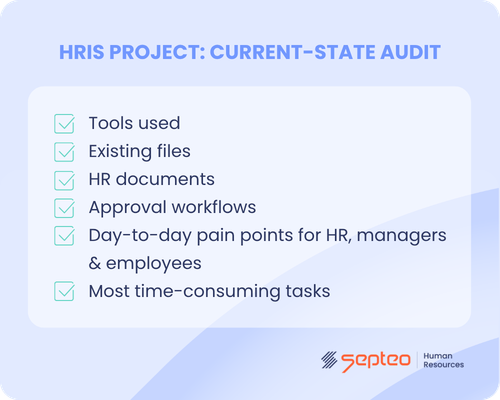
The audit should cover the software currently in use, existing files, HR documentation, and approval workflows. It should also identify day-to-day pain points and the most time-consuming tasks for HR teams, managers, and employees.
This analysis makes it possible to distinguish what is already working well, what needs to be streamlined, and what should be reconsidered altogether.
The audit should also highlight any gaps between official processes and actual practices. This is often a critical insight. In many organizations, documented procedures no longer fully reflect how teams operate on a daily basis. An HRIS project is therefore an opportunity to realign practices before integrating them into the system.
An HRIS project must be driven by clear, well-defined objectives. Without a solid direction, the risk is to compare solutions solely based on feature lists, whereas an HRIS should address core business priorities.
The first question to ask is straightforward: what is the primary challenge you want to solve?
For example, your project may aim to achieve:
- Time savings for HR teams
- Improved data reliability or faster approval processes
- Greater visibility for managers
- Simplified HR reporting
These objectives should then be prioritized. Some relate to day-to-day efficiency, such as reducing duplicate data entry or automating reminders. Others address more strategic challenges, such as harmonizing practices across multiple sites or strengthening the compliance and security of HR processes.
It is better to define a limited number of measurable objectives rather than aiming for an overly broad ambition. These objectives can, and should be very concrete.
For example, you may aim to:
- Reduce HR request processing times
- Improve completion rates of employee records
- Enhance the reliability of data transmitted to payroll
This clarification also helps secure stakeholder buy-in. Managers are unlikely to be convinced by a message focused solely on HR digitalization.
They will be far more engaged if the project simplifies their day-to-day work, for instance, by enabling faster approvals, better team oversight, or access to accurate information at the right time.
Before comparing solutions on the market, it is therefore essential to clearly define the drivers behind your project. To explore these challenges further, read our dedicated article: Why implement an HRIS?
Step 3: establish HRIS project governance
An HRIS project extends beyond the HR team. It involves managers, employees, IT, payroll, and sometimes finance or legal departments.
HR leads the business requirements. Executive leadership provides direction and arbitrates priorities. IT validates aspects related to security, access, and integrations. Managers should also be closely involved, as they will be among the primary end users of the future system.
It is advisable to set up a clear and streamlined governance structure. This can include a project sponsor, a project manager, HR representatives, and pilot users. An IT point of contact is also essential, particularly when the project involves system integrations or security considerations.
| Operator | Role in the HRIS project |
| Project sponsor | Defines the vision, arbitrates priorities and secures key decisions |
| HR project manager | Coordinates timelines, workshops, validations and interactions with the software publisher. |
| Business representatives | Capture operationak needs and test target processes |
| IT | Validates technical aspects, access management, security and system integrations |
| Pilot managers | Test real-life use cases and support adoption across their teams. |
| Utilisateurs finaux | Remontent les irritants et valident la simplicité des parcours |
Step 4: Define the scope of your HRIS project
The functional scope must be clearly defined. It determines what will be deployed as a priority and what can be implemented at a later stage.
Organizations may choose to start with a core HRIS foundation or prioritize specific modules such as absence management, time tracking, performance reviews, training, or recruitment. The right approach depends on the most pressing pain points and the team’s capacity to deliver the project.
Deploying everything at once is not always the best option. A phased approach often helps secure early wins and drive user adoption. It also reduces the “tunnel effect” commonly seen in overly ambitious projects from the outset.
The scope should also take into account budget, internal resources, and the company’s HR calendar. For instance, launching a performance review module during an ongoing review cycle may create confusion. Similarly, deploying a training module without clearly defined policies can slow down adoption.
Note: For SMEs, this consideration is particularly critical. An HRIS should structure the HR function without adding unnecessary complexity. It must be comprehensive enough to support growth, yet simple enough to ensure rapid adoption. To learn more, explore our recommendations on how to choose an HRIS tailored for SMEs
Step 5: Draft the HRIS requirements specification
The requirements specification formalizes needs, constraints, priorities, and selection criteria. It serves as the foundation for discussions with software publishers.
Its purpose is not just to list features.
It should translate HR challenges into concrete requirements. This includes the processes to be covered, data to be migrated, expected integrations, and access rules.
For example, rather than simply requesting a “performance review module,” specify the expected use cases: tracking review cycles, sending reminders to managers, and maintaining a history of completed reviews.
A well-structured specification should also clarify key decisions already made. Are processes standardized or do they vary across entities? Will all managers have the same access rights? Should the solution integrate with a payroll system, a digital document vault, or a recruitment platform?
The clearer the specification, the more comparable vendor responses will be. It also helps prevent unexpected issues during deployment. To support this step, refer to our dedicated guide on how to write an HRIS requirements specification.
Step 6: select the right HRIS solution
Choosing an HRIS should be based on the company’s actual needs. It must also reflect the organization’s HR maturity and growth trajectory.
A solution that is too limited may quickly become a constraint. Conversely, a solution that is too complex can slow down adoption. The right HRIS should address current priorities while remaining scalable.
Several criteria should be carefully assessed: functional coverage, modularity, user experience, and data security. Configuration capabilities, integrations, and the quality of support are also key factors.
It is equally important to evaluate the vendor’s ability to support the project over time. The quality of customer support, deployment methodology, and understanding of HR challenges often make a significant difference after the contract is signed.
A modular solution offers a strong advantage. It allows organizations to start with their most critical processes and expand gradually. This step-by-step approach ensures consistency while supporting sustainable growth.
Step 7: anticipate data migration in your HRIS project
Data migration is one of the most sensitive workstreams in an HRIS project. It is often seen as a purely technical step, whereas it directly determines the quality and reliability of the future system.
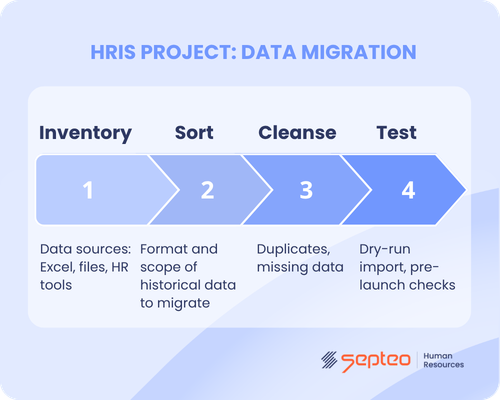
The first stage is to identify all data sources. These may include Excel files, a legacy HRIS, payroll systems, shared folders, or even paper records.
Next, it is essential to define which data should be migrated, in what format, and with what level of historical depth.
A data cleansing phase is usually required. Duplicates must be removed, formats standardized, and outdated data discarded. Missing information, such as reporting lines, key dates, or employee status, must also be completed.
The migration should then be thoroughly tested. A trial import helps verify that data is correctly integrated and that business rules are functioning as expected. This step is crucial to avoid identifying issues at the time of go-live.
Step 8: support users and drive adoption
The success of an HRIS project is not only measured by meeting deployment timelines—it is above all reflected in actual system usage.
A solution may be perfectly configured, yet underutilized if users do not understand its value. Change management must therefore be treated as a core phase of the project.
Support should be tailored to each audience:
- HR teams must be fully confident in managing processes and administering the system
- Managers need to clearly understand how the HRIS simplifies their daily tasks
- Employees should quickly see the tangible benefits for their requests, documents, and personal information
Training plays a critical role. It should be practical, contextualized, and usage-oriented. Users need to relate to real-life scenarios rather than follow a generic feature-based presentation.
Choosing a structured training provider can significantly enhance onboarding quality. To explore this topic further, read our article on the benefits of selecting a Qualiopi-certified training provider for HRIS user training.
How to measure the succes of an HRIS project?

Measuring user adoption
The success of an HRIS project cannot be assessed solely at go-live. A solution may be delivered on time without delivering the expected benefits.
The first step is to ensure that actual usage is well established. Are HR teams actively using the system? Are managers completing the expected actions? Are employees logging in to access their information?
Monitoring these usage patterns is essential to confirm that the solution has been fully adopted across the organization.

Measuring process efficiency
Next, it is essential to assess the quality and efficiency of processes. Approval cycles should be faster, and the need for follow-ups should be reduced. Employee records should also be more complete and better maintained.
The objective is to ensure that the HRIS genuinely simplifies day-to-day operations. If teams continue to rely heavily on parallel tools such as Excel, this is a clear signal that adjustments are needed.

Measuring the value delivered through data quality
A successful HRIS project should free up HR time, reduce errors, and improve access to information. It should also strengthen HR decision-making and overall workforce management.
Data quality is a key indicator. Information must be complete, consistent, and actionable
Ultimately, success should be measured across three dimensions: user adoption, operational efficiency, data quality.
HRIS project: common mistakes to avoid
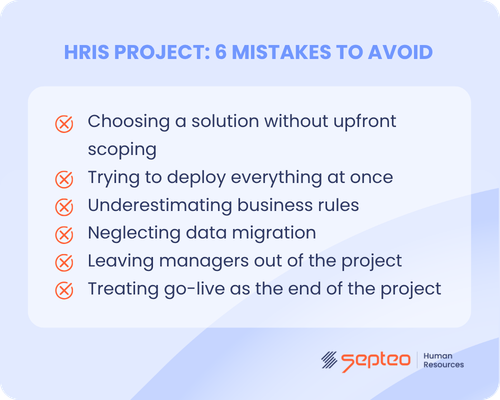
A product demonstration can be compelling, but it is no substitute for a thorough business needs assessment.
Without a clear analysis of processes, organizations risk selecting an attractive solution that is ultimately misaligned with their actual use cases.
An overly broad scope can lead to project fatigue and slow down adoption.
It is often more effective to successfully implement a solid initial foundation, then expand progressively over time.
Business rules must be clearly defined before configuration begins. Who approves requests? Who can access sensitive data? Which workflows should be standardized across all entities?
These questions may seem operational, but in reality, they are fundamental—they shape the entire structure of the project.
Incomplete or inconsistent data can quickly undermine user trust from the moment the system goes live. HR data must therefore be carefully prepared, cleansed, and thoroughly tested.
This is a critical condition for building confidence in the new solution and ensuring successful adoption.
Managers often play a central role in approvals, performance reviews, recruitment, and training processes.
If they are not properly involved, the HRIS risks remaining an HR-only tool. Instead, it should become a shared platform that supports collaboration across the organization.
Go-live marks the beginning of an adjustment phase, not the end of the project. User feedback must be carefully analyzed.
Early usage metrics are also essential to identify pain points and continuously improve the solution.
Turning your HRIS project into a driver of HR performance
Successfully delivering an HRIS project requires a structured approach. Choosing the right solution is important, but it is not enough. Success also depends on thorough preparation. Scoping, data quality, and user support are all critical factors.
A well-executed HRIS project simplifies the day-to-day work of HR teams. It improves data reliability, secures processes, and enhances the employee experience. It also provides decision-makers with clearer visibility into the organization.
With mpleo, you can structure your HRIS project progressively by activating the modules that align with your priorities. This step-by-step approach allows you to move at your own pace while building a solid HR foundation designed to support the entire employee lifecycle.
Get in touch with our teams to identify your needs, define your project, and discover how mpleo can support your organization.
FAQ – HRIS project
The timeline of an HRIS project primarily depends on its scope and the number of modules to be deployed. It also varies based on data quality, required integrations, and the availability of internal teams.
A focused project can be rolled out progressively, while a broader initiative covering multiple HR processes requires more comprehensive planning and scoping.
The cost of an HRIS project depends on several factors, including the number of users and the modules selected. It also varies according to the level of configuration required, data migration complexity, integrations, and the scope of support provided.
Internal costs should also be considered, particularly the time dedicated to the project, user training, and change management efforts.
The right HR software is one that meets the organization’s current needs while remaining flexible enough to evolve over time. It should be user-friendly, secure, scalable, and easy to integrate with other systems.
Above all, it must align with the day-to-day needs of HR teams, managers, and employees, ensuring strong adoption and long-term value.
An HRIS project is typically led by the HR department, as it owns the business requirements and use cases.
However, it should involve multiple stakeholders: executive leadership, IT, managers, payroll, and selected key users.
This governance structure helps ensure informed decision-making, alignment with technical constraints, and strong user adoption across the organization.
Data migration directly impacts the reliability of your future HRIS. Incomplete, outdated, or poorly structured data can slow down deployment and undermine user confidence from the outset.