Online training software Deploy and manage your e-learning courses
The online training software mpleo allows you to centralize your e-learning content, structure the courses, and precisely measure the impact of your digital training efforts.
An online training software to support your HR challenges

Accessibility
Provide your team with easy and flexible access to their digital training, wherever they are and at any time.

Commitment
Design pathways tailored to job profiles to enhance engagement and autonomy in skill development.

Management
Track progress, time spent, and results in real-time with consolidated and actionable indicators.
Simplify the management of your digital training daily
Discover the key features of mpleo to structure your e-learning strategy and enhance visibility.
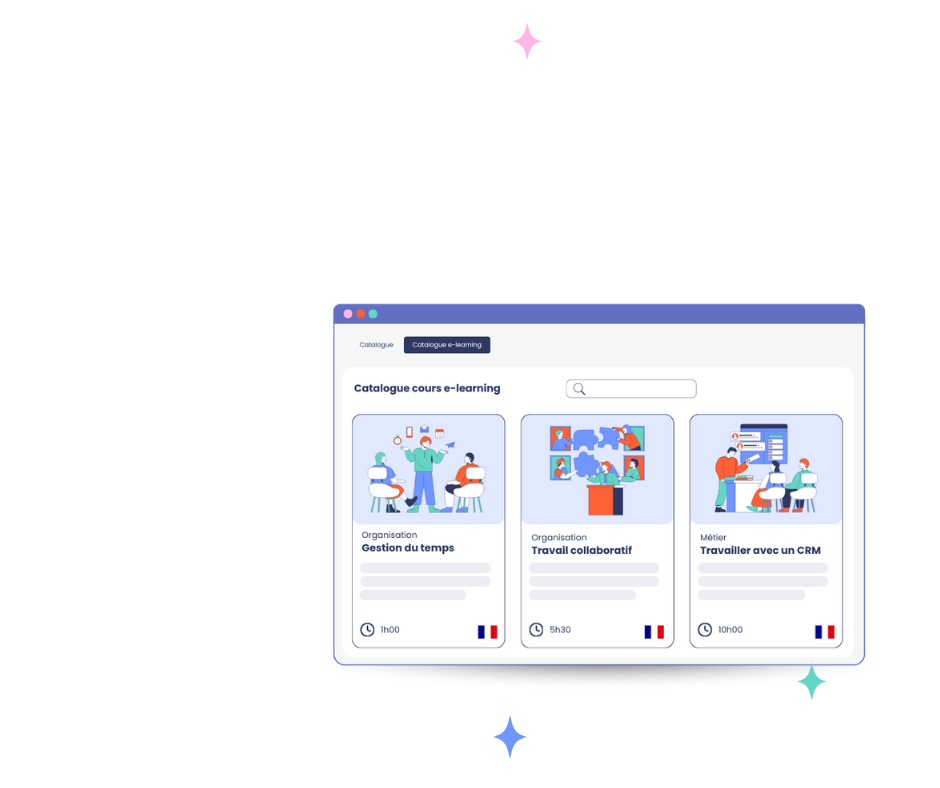
Centralized e-learning Catalog
Centralize all your online training content in a single catalog.
The software supports standard SCORM formats and allows you to easily manage your digital modules. Organize your training according to business needs and control content distribution to targeted groups.

Structured Training Paths
Build coherent and progressive digital pathways to guide your team.
Each user accesses a training path tailored to their role, level, or goals. This structure enhances clarity of expectations and eases the acquisition of key skills.

Status Tracking and Progress
View training progress in real-time: not started, in progress, or completed.
HR teams and managers have immediate visibility on employee progress. Quickly identify any delays and adjust or prompt actions as needed.

Analysis of Time Spent and Results
Accurately measure learner engagement and performance.
The mpleo online training software allows analysis of time spent on each module and the scores achieved. This data aids in evaluating educational effectiveness and adjusting content if needed.


Efficiently manage your e-learning strategy
Explore all the features of the online training software mpleo.
Access consolidated metrics to analyze completion rates, performance, attendance, and training distribution by department. Gain a clear view to adjust your strategy.
Assess the impact of your digital modules on skill development. The collected data allows you to make informed decisions and optimize your training investments.
The e-learning module seamlessly integrates with your overall HRIS. Training data enriches the employee record and can support evaluations, skill management, or development plans.
Regain Control of Your Digital Training
Discover how the online training software mpleo helps you structure your courses, engage your team, and efficiently manage skill development.
FAQ – Online Training Software
E-learning makes training more accessible, flexible, and continuous. Employees can develop their skills at their own pace, without major logistical constraints, which strengthens engagement and autonomy.
For HR teams, online training simplifies large-scale deployment and ensures consistent, standardized content. It becomes a strategic lever to support business transformation and maintain employee employability.
E-learning does not necessarily replace classroom-based training, it enhances it. A blended learning strategy combines digital modules, in-person sessions, and managerial support to maximize learning impact.
An online training platform enables you to integrate these hybrid learning paths into a unified vision. This allows you to structure coherent, business‑aligned programs that meet the needs of your organization.
An online training software is a solution that allows organizations to deliver, manage, and track digital learning content. It centralizes e‑learning modules, structures learning paths, and provides full visibility into learners’ progress.
It enables HR teams to manage remote training while measuring its effectiveness. It is a key tool for supporting skill development in a hybrid work environment.
An LMS (Learning Management System) is a platform specifically designed to manage and track digital training programs. The mpleo online training software fulfills this role while being fully integrated into a broader HRIS.
This means that data from e‑learning paths is directly connected to skills, performance review, and training modules. As a result, you benefit from a unified and comprehensive view of talent development.
Yes. The mpleo E‑learning module is fully compatible with SCORM standards, allowing you to integrate content produced by various training providers or publishers.
This compatibility ensures optimal interoperability and makes it easy to import your existing modules. You can centralize all your learning content within a single unified environment.
Yes. The software allows you to view the status of each training module (not started, in progress, completed), as well as the time spent and the scores achieved.
These indicators provide detailed insights into learner engagement and make it easier for HR teams and managers to monitor and manage training activities.
Integrated dashboards allow you to analyze completion rates, performance levels, and learner attendance.
This data helps you assess the relevance of your training content, identify areas for improvement, and demonstrate the impact of your learning initiatives to leadership.
Yes. The online training software is fully connected to the other modules within the mpleo HRIS.
Data from digital learning paths enriches skills assessments and can be used to inform performance reviews or development plans. This level of integration ensures a coherent, data‑driven HR strategy.
The mpleo e‑learning module is primarily designed for HR training management: tracking sessions, monitoring budgets, and ensuring direct integration with employee records. It allows you to manage the entire skills development plan within a single HRIS environment, without multiplying tools.
An LMS, on the other hand, focuses on the learning experience and content creation. It is often separate from HR processes and requires additional synchronizations to ensure reliable tracking within employee files.